whats-this-pr
A Claude skill that turns a pull request into one page you can review in minutes.
Profiles load from a cache, and the database only on a miss
Add a small cache with a five-minute expiry
Hover a note to see it in the code
Ask the cache before the database
Hover a note to see it in the code
1 file you don’t need to read
lockfile1Regenerated for redis
- package-lock.json+16 −1
The problem
Agents now write more code than people can comfortably read, and every line of it still lands in a pull request that someone has to review. Opening one, it’s hard to tell what the pull request is actually about, and how merging it would change the way the code behaves.
The idea
A way to see what a pull request changes in how the code behaves, before and after, without reading the diff first.
Then a guide through the diff that points me to exactly where to look.
How it works
It’s a skill for Claude. Run /whats-this-pr:whats-this-pr with a pull request’s link, and it reads the change and the code around it.
What comes back is an artifact: one page with the diagram and the guided story, like the one above, ready to share with whoever reviews it.
Decisions
- It only reads: it never comments on, reviews or labels a pull request.
- It draws the old behaviour too, because what quietly stops is easy to miss in a diff.
- It checks the description against the code, and says when they disagree.
- It says why to look, never whether the code is right.
Limitations
- It only works with GitHub, since it reads pull requests through GitHub’s API.
- Without a description, it can say what a pull request does, but not whether that’s what the author meant.
- Ruby, PHP, C, C++ and Swift show as plain text, without syntax colours, to keep the page small enough to publish.
- You can’t comment from the page yet. Posting comments to the pull request from it is planned.
- The diagram suits changes in behaviour. A refactor, a docs change or a styling change has little to draw.
- It never runs the code, so anything only running it could prove is marked unchecked.
- A page is a snapshot. New commits on the pull request mean making it again.
Install
You need Claude Code, the GitHub CLI signed in (gh auth login), and Node.js 20 or later. In Claude Code, add the plugin’s marketplace and install it:
/plugin marketplace add HelixMorphe/whats-this-pr
/plugin install whats-this-pr@whats-this-prThen run it with a pull request’s link:
/whats-this-pr:whats-this-pr https://github.com/owner/repo/pull/123It reads the pull request and the code around it through GitHub, writes the page, and publishes it as an artifact, or hands you the HTML file. It never comments on the pull request, and never runs its code.
The npm package also works on its own, if you’d rather write the two data files yourself. It turns the story into data, checks both files against the template, and makes the page:
npx whats-this-pr story story.json pr.diff -o pr.json
npx whats-this-pr check pr.json hero.json
npx whats-this-pr make pr.json hero.json -o page.htmlExamples
Pages the skill wrote for real pull requests, all merged:
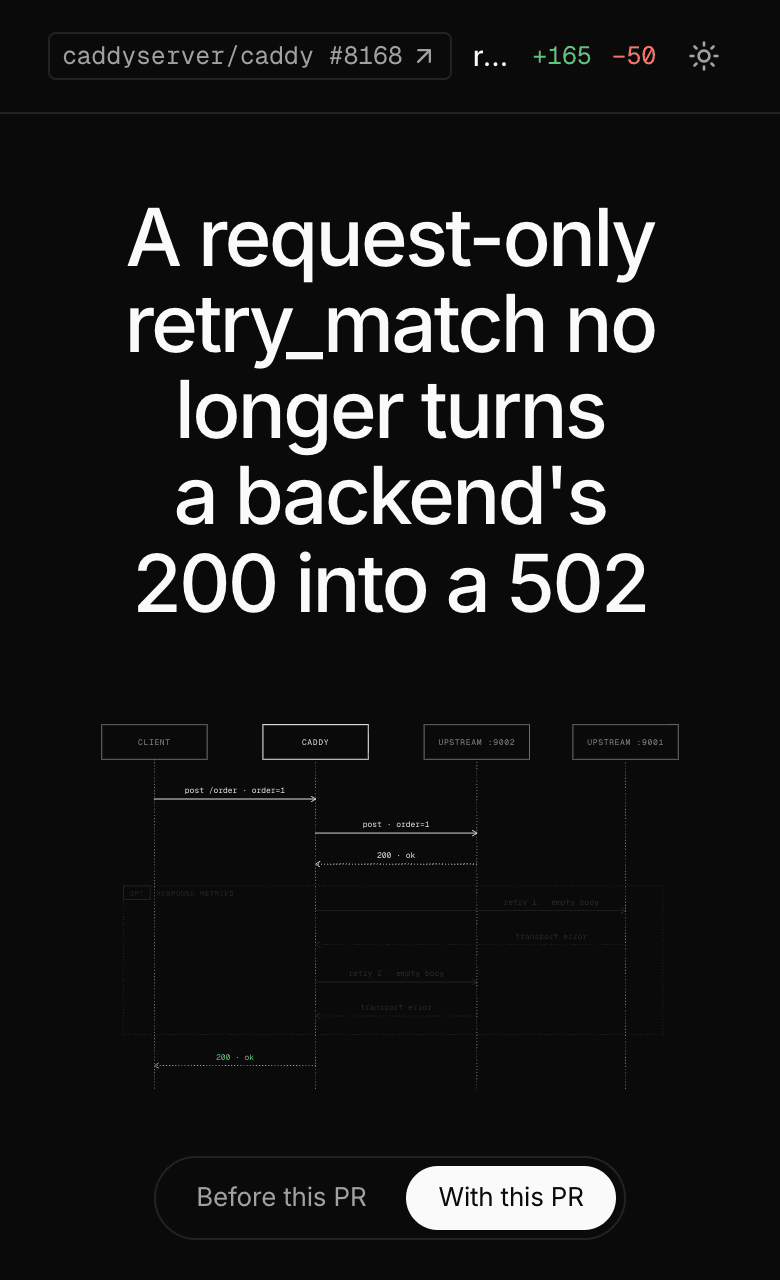
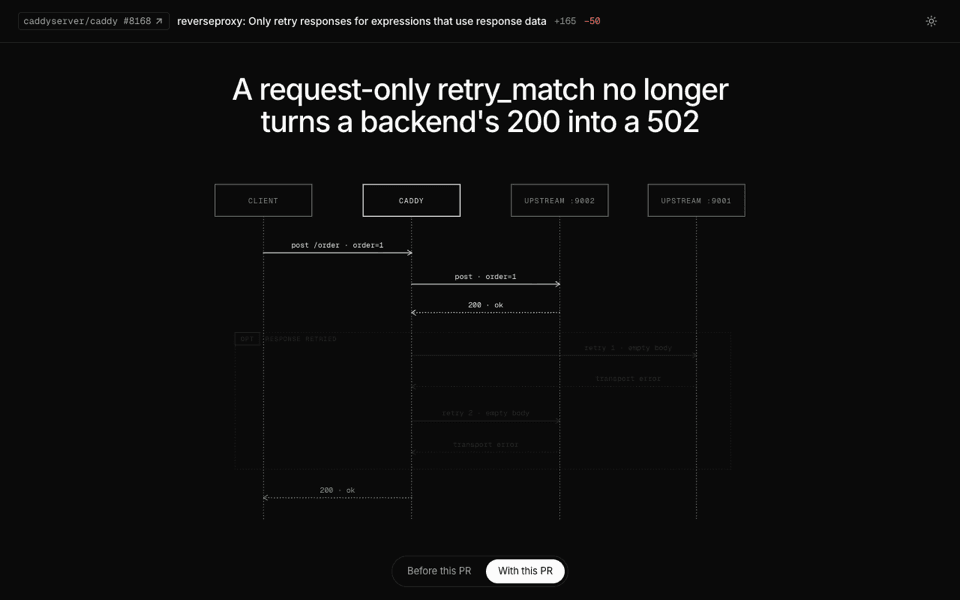
Source
- the repogithub.com/HelixMorphe/whats-this-pr
- the skillplugins/whats-this-pr/skills/whats-this-pr
- the packagenpmjs.com/package/whats-this-pr